Newsletter Subscribe
Enter your email address below and subscribe to our newsletter

 ByJohn A
Temperature measurement is essential in many industrial processes where even a small change can affect product quality, equipment performance, or operating safety. Thermocouples are widely used for this purpose because they are relatively simple, durable, and suitable for a broad range of operating conditions. Among the different categories available, base-metal designs are commonly selected for general industrial temperature measurement.
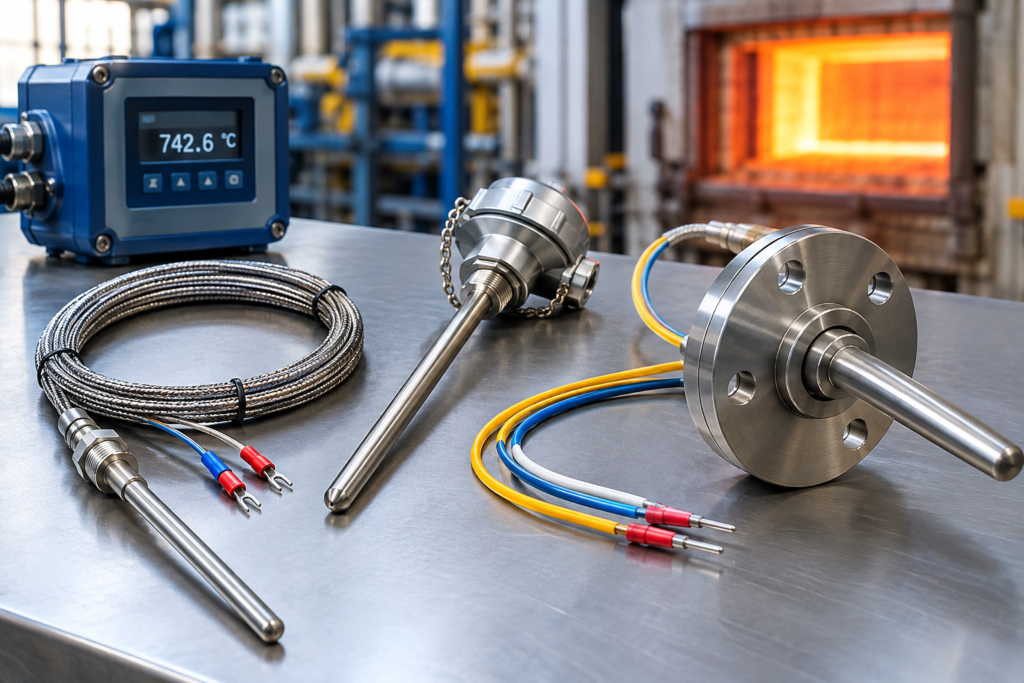
A base metal thermocouple is a temperature-sensing device made from combinations of relatively common metallic alloys rather than noble metals such as platinum and rhodium. It generates a small electrical voltage when its two dissimilar metal conductors experience a temperature difference.
The voltage produced is related to the temperature at the measuring junction. An instrument connected to the thermocouple interprets this electrical signal and displays the corresponding temperature.
Several standardized thermocouple types fall into the base-metal category. Type K, Type J, Type T, and Type E are among the most frequently encountered. Each uses a different combination of metals and therefore has different temperature limits, sensitivity, and resistance to environmental conditions.
The choice depends largely on the application. A thermocouple used inside a furnace may require different materials and protection from one installed in food-processing equipment or laboratory machinery.
See also: Expert Ottawa Career Coaching for Career Success
The operating principle behind a thermocouple is known as the Seebeck effect. When two dissimilar conductors are joined and the junctions are exposed to different temperatures, an electromotive force is produced.
A typical thermocouple assembly contains:
The measuring junction is positioned at the location where temperature needs to be monitored. The other end connects to an instrument capable of interpreting the thermoelectric signal.
Accuracy depends on several factors, including the quality of the thermocouple wire, junction construction, calibration, reference-junction compensation, installation method, and surrounding environment.
Thermocouples also have a relatively fast response compared with some other temperature sensors, although response time varies according to probe diameter, sheath material, insulation, and installation conditions.
Different thermocouple types use specific alloy combinations.
Type K generally uses nickel-chromium and nickel-aluminium alloys. It is widely used because of its broad temperature capability and suitability for many industrial applications.
Type J uses iron and constantan. It is commonly used in older industrial equipment and applications where its particular temperature characteristics are appropriate.
Type T combines copper and constantan. It performs well at lower temperatures and is frequently used in laboratory, refrigeration, and food-related applications.
Type E uses nickel-chromium and constantan. It provides relatively high thermoelectric output and can be useful where greater signal strength is desirable.
The choice should account for temperature range, atmosphere, mechanical conditions, expected service life, and compatibility with surrounding materials.
Temperature sensors are found throughout manufacturing and process industries. Furnaces, ovens, kilns, heat-treatment equipment, boilers, dryers, engines, and processing machinery can all require continuous or periodic temperature measurement.
In high-temperature equipment, the sensor must withstand more than heat alone. Oxidation, vibration, chemical exposure, abrasion, thermal cycling, and mechanical impact can shorten its useful life.
Installation is also significant. A poorly positioned probe may measure the temperature of a wall, flame, or surrounding gas instead of the material or process being monitored. Excessive insertion depth, inadequate protection, or incorrect placement can similarly affect readings.
For this reason, thermocouple selection should be considered alongside the physical conditions surrounding the sensor.
Industrial machinery operating under abrasive or high-temperature conditions can experience gradual surface degradation. Particles, heat, impact, and corrosive substances may wear down exposed components.
In such environments, component coating services can be used to apply protective materials to selected surfaces. The coating is chosen according to the type of wear or environmental exposure expected.
Coatings may be designed to reduce abrasion, resist oxidation, improve surface durability, or provide protection against particular operating conditions. Their suitability depends on the substrate material, application method, temperature range, and expected mechanical stresses.
Thermocouple protection can also involve specialized sheaths, ceramic tubes, or metallic protective tubes. These components help isolate the sensing element from direct contact with aggressive process conditions while allowing temperature to be measured.
Mining, quarrying, aggregate handling, and construction equipment can encounter continuous contact with rocks and other abrasive materials. Components exposed to these conditions may require additional surface protection.
Anti rock coatings are designed for applications where impact and abrasion from rock or mineral particles can cause rapid surface wear. Such coatings may be applied to equipment surfaces that experience repeated contact with abrasive material.
Buckets, chutes, wear plates, and other machinery can face particularly demanding conditions. The appropriate coating depends on the hardness and size of the material being handled, impact frequency, operating temperature, and underlying substrate.
For excavator and loader buckets, bucket anti rock coatings can be considered as part of a broader wear-management program. The aim is to protect vulnerable surfaces and help equipment withstand repeated exposure to abrasive loads.
These coating technologies are separate from the thermocouple itself, but they can be relevant in facilities where temperature-monitoring equipment operates alongside heavily exposed industrial machinery.
Combustion equipment presents another demanding environment for temperature sensors. Furnaces, burners, incinerators, boilers, and industrial heating systems can reach high temperatures while producing gases and combustion by-products.
A thermocouple installed in such equipment must be selected according to the actual gas temperature, atmosphere, mechanical exposure, and expected operating cycle.
Protective coatings may also be used on selected combustion-system components. Combustion systems coating can provide a protective surface layer intended for specific thermal, chemical, or wear conditions.
The sensor itself may require a protective sheath or ceramic protection, depending on the application. Direct exposure to flame, corrosive gases, or rapidly changing temperatures can influence sensor life and measurement stability.
Several technical factors should be reviewed before choosing a thermocouple for an industrial installation.
Temperature range: The selected thermocouple type must be suitable for both normal and maximum expected temperatures.
Operating atmosphere: Oxidizing, reducing, inert, or vacuum conditions can affect thermocouple materials differently.
Mechanical exposure: Vibration, pressure, impact, and abrasion may require a reinforced construction or protective sheath.
Response time: Smaller probes generally respond more quickly, while thicker protective assemblies may provide greater mechanical protection.
Accuracy requirements: The thermocouple type, wire grade, calibration, installation, and instrumentation all contribute to the final measurement accuracy.
Chemical compatibility: Process gases, liquids, and vapors can attack thermocouple wires or protective materials.
Installation method: Probe length, mounting arrangement, junction type, and location should correspond to the process being measured.
Regular inspection can help identify problems before they lead to inaccurate temperature readings. Common warning signs include unstable readings, unusually slow response, visible oxidation, cracked insulation, damaged sheaths, and changes in calibration.
Thermal cycling can gradually affect thermocouple materials. Repeated heating and cooling may cause mechanical stress, while exposure to contaminants can alter the sensing junction.
Calibration checks are useful in applications where temperature accuracy directly affects production or equipment control. The appropriate inspection interval depends on the thermocouple type, operating environment, required accuracy, and consequences of measurement errors.
Protective tubes and sheaths should also be examined for cracks, thinning, corrosion, or other forms of deterioration.
There is no single thermocouple construction suited to every industrial process. The right selection begins with the conditions at the measurement point.
Temperature range determines which thermocouple types are suitable. The surrounding atmosphere influences material selection. Mechanical exposure determines the level of protection required. Process requirements establish the acceptable measurement accuracy and response time.
A sensor installed in a relatively clean, moderate-temperature environment may need little protection. A sensor positioned inside a furnace, combustion chamber, or abrasive process may require specialized construction and additional protection.
Understanding these factors before installation can reduce premature failures and improve the reliability of temperature measurements.
Base-metal thermocouples remain widely used for industrial temperature measurement because different types can address a broad range of applications. Their performance depends not only on the thermocouple alloy but also on installation, protective materials, environmental conditions, and maintenance.
For demanding industrial environments, temperature measurement should be considered alongside the wider equipment conditions. Abrasion, impact, combustion gases, and high temperatures can affect surrounding machinery as well as the sensing assembly. Selecting suitable materials and protective measures can therefore contribute to more consistent operation and longer service intervals.