
Buy an AI agent when the workflow is common, such as IT helpdesk or customer support, and speed matters more than differentiation. Build when the agent touches proprietary processes, sensitive data, or core systems. Bought agents usually go live in weeks; custom AI agent development typically takes three to nine months and costs more upfront.
Agent pitches are everywhere, and most enterprise leaders now face the same question: should we build AI agents ourselves or buy one off the shelf?
Getting it wrong is expensive. Gartner predicts that over 40% of agentic AI projects will be canceled by the end of 2027 because of rising costs, unclear value, or weak risk controls. A clear build-vs-buy decision is one of the best defenses.
What is an AI agent?
An AI agent is software that uses a large language model to plan and carry out multi-step tasks, calling tools and systems on its own rather than only answering questions. A chatbot replies; an agent acts, for example by updating a CRM record, issuing a refund, or opening a ticket.
That ability to act is what makes the build-vs-buy decision harder.
Build vs. buy AI agents: timelines and costs compared
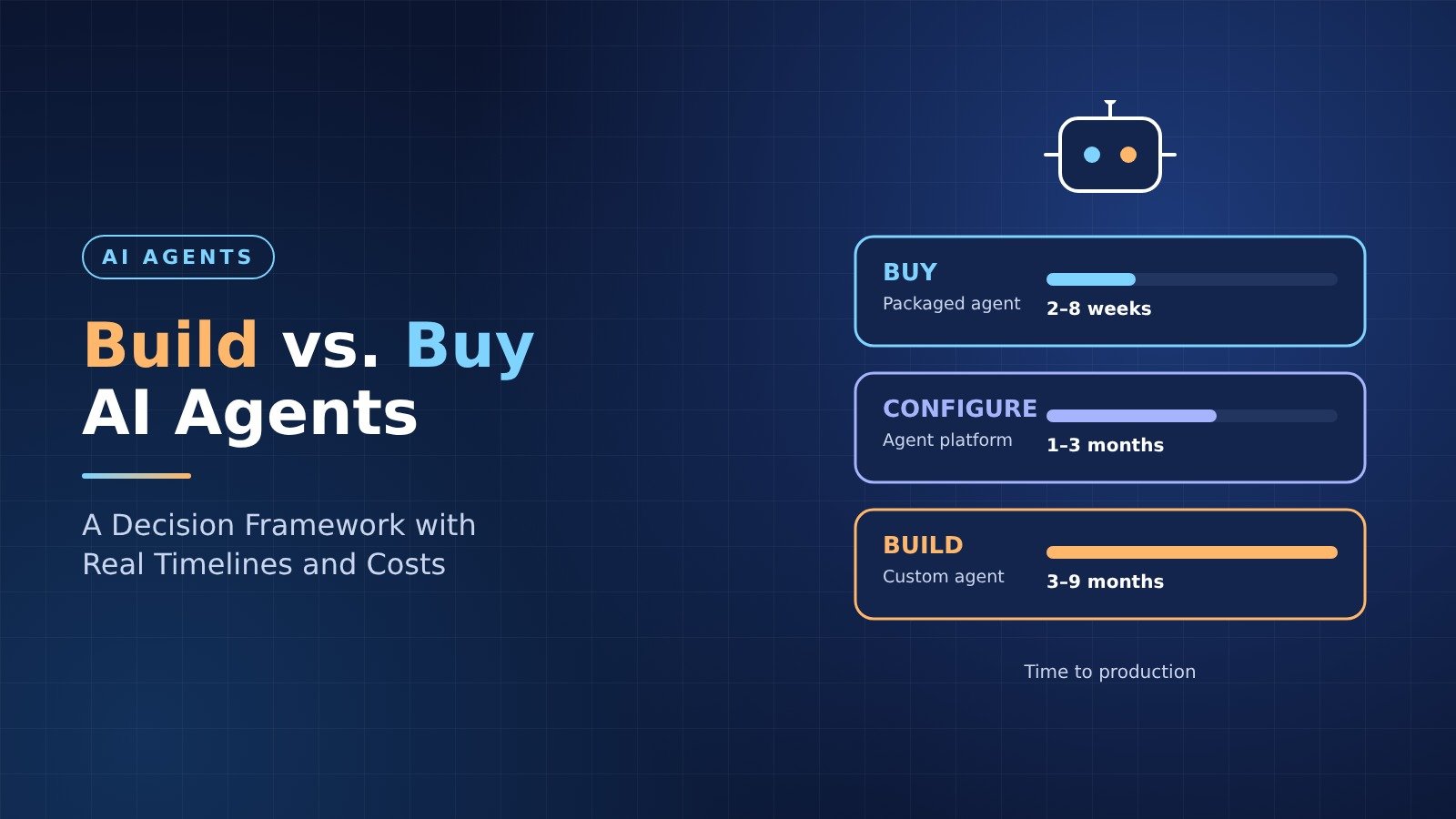
Most organizations choose among three paths, not two. The ranges below are indicative and vary by scope, region, and integration depth.
Buy (packaged agent):
- Time to production: 2–8 weeks.
- Cost: low upfront; ongoing per-seat or per-task fees.
- Customization and data control: limited and vendor-dependent.
- Best for: standard workflows.
Configure (agent platform):
- Time to production: 1–3 months.
- Cost: moderate upfront; platform fees plus model usage.
- Customization and data control: moderate and shared.
- Best for: semi-custom processes.
Build (custom agent):
- Time to production: 3–9 months.
- Cost: high upfront for an engineering team; ongoing model usage, hosting, and maintenance.
- Customization and data control: full.
- Best for: differentiating, high-risk processes.
As a rough benchmark, a production-grade custom agent with several system integrations often costs in the low-to-mid six figures (USD) in its first year, once evaluation, security review, and monitoring are included. Model usage alone is rarely the largest line item. Integration and testing usually are.
See also: Business Dissolution Attorney: Common Legal Issues During Company Closure
How do you decide whether to build AI agents or buy them?
Decide by scoring the workflow on differentiation, data sensitivity, integration complexity, and in-house skills. Use this five-step framework:
- Map the workflow. Document every step, system, and human approval the agent would touch.
- Score differentiation. If competitors run the same process the same way, buying is usually enough.
- Assess data and risk. Agents that handle regulated data, payments, or customer commitments need tighter control, which favors building or a configurable platform.
- Count the integrations. More than three or four custom system connections often make packaged agents fragile.
- Check internal capacity. Building requires engineers who can manage prompts, tool permissions, evaluation sets, and incident response.
Low differentiation and low risk point to buying; high scores on both point to building or configuring.
Hidden costs that change the build-vs-buy math
The quoted price is rarely the real price. Teams that build AI agents, and teams that buy them, often miss these costs:
- Evaluation. Agents need test suites of realistic tasks, rerun after every model or prompt change.
- Guardrails and permissions. Every tool an agent can call needs scoped access and audit logs.
- Human review. Early deployments usually need people to approve high-impact actions.
- Model changes. Provider model updates can change agent behavior without warning.
- Vendor lock-in. Packaged agents may store workflow logic in formats that are hard to export.
[IMAGE PLACEMENT] Decision tree showing build, configure, or buy based on differentiation, risk, and integration count.
Alt text: “AI agent development decision tree comparing build, configure, and buy options”
A real-world scenario: two agents, two answers
Consider a logistics company with two candidate agents. The first resets passwords and answers HR policy questions. It’s standard, low-risk, and well served by packaged agents, so the company buys and goes live in six weeks.
The second agent reroutes shipments when carriers report delays. It uses proprietary pricing rules and writes to the transport management system. Here the company builds, starting with a human-approved pilot on one route before expanding.
Common mistakes in AI agent development
- Starting with full autonomy. Agents should earn autonomy through measured accuracy, not launch with it.
- Treating a demo as a product. A demo handles the happy path; production handles exceptions.
- No owner after launch. Agents drift as data, models, and processes change.
- Buying “agents” that are just chatbots. Gartner has warned about “agent washing,” where vendors rebrand existing tools as agents.
Key Takeaways
- Buy AI agents for standard, low-risk workflows; build for differentiating or high-risk ones.
- Packaged agents go live in weeks; custom AI agent development usually takes three to nine months.
- Integration, evaluation, and governance drive cost more than model usage does.
- Start with human-approved actions and expand autonomy as accuracy is proven.
Conclusion
Build vs. buy is not a one-time decision. Most enterprises will run a mix of packaged and custom agents. The organizations that succeed with AI agent development will be the ones that apply the same evaluation, permission, and ownership standards to every agent, whoever wrote it.
FAQ
How much does it cost to build an AI agent?
Costs vary widely with scope. A simple internal agent with one or two integrations may cost tens of thousands of dollars. A production agent with several system integrations, security review, and evaluation often reaches the low-to-mid six figures in year one. Ongoing model usage, hosting, and maintenance add recurring costs.
How long does AI agent development take?
A packaged agent can go live in two to eight weeks. A configured agent on a platform typically takes one to three months. Custom AI agent development usually takes three to nine months, depending on integrations, data readiness, compliance requirements, and how much human review the first release needs.
What is the difference between an AI agent and a chatbot?
A chatbot answers questions in a conversation. An AI agent plans and completes multi-step tasks by calling tools and systems, such as updating records, sending emails, or creating tickets. Because agents take actions, they need stronger permissions, logging, testing, and human oversight than chatbots do.
When should a company build AI agents instead of buying them?
A company should build AI agents when the workflow is a competitive differentiator, involves sensitive or regulated data, or depends on several proprietary systems. Building also makes sense when packaged options can’t meet audit, data residency, or customization requirements. Standard, low-risk workflows are usually better served by buying.
What are the biggest risks of deploying AI agents?
The biggest risks are incorrect actions taken at scale, excessive system permissions, data leakage, and behavior changes after model updates. Prompt injection, where malicious input manipulates the agent, is another serious concern. Scoped permissions, human approval for high-impact actions, audit logs, and regular evaluation reduce these risks.