Newsletter Subscribe
Enter your email address below and subscribe to our newsletter

 ByJohn A
Boat shade does not have to mean drilling into the deck, adding permanent hardware, or leaving a bulky frame in place. A rod holder shade pole uses the rod holders already installed on the boat as mounting points. The pole sits securely in the holder while a tensioning system keeps the shade fabric positioned above the desired area.
The setup is particularly useful for boats where fishing access, casting space, and a clear deck matter. Fixed-length poles can be installed when shade is needed and removed afterward, leaving the rod holders available for their usual purpose. The system is designed around standard 1.5-inch rod holders and is available in fixed 6 ft and 8 ft pairs, depending on the application.
For boats that need a removable shade arrangement without permanent modifications, a rod holder shade pole provides a practical mounting approach.
A rod holder shade pole is a fixed-length support pole that fits into an existing rod holder and supports a shade panel above the deck. Instead of relying on drilled mounts or multiple support straps, the pole works with the rod holder and a tensioning arrangement to keep the fabric taut.
The design needs to handle several requirements at once. The pole must remain stable, the fittings must withstand marine conditions, and the fabric needs enough tension to maintain its position without placing unnecessary strain on the mounting points.
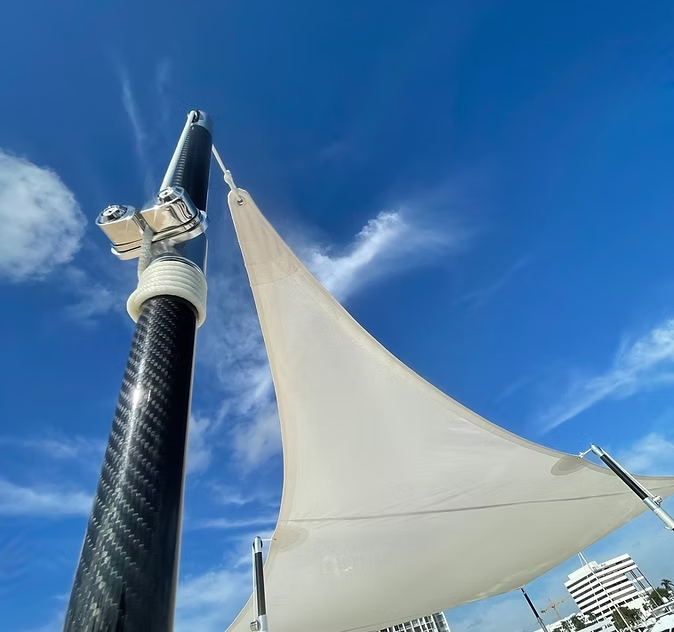
The lower end of the pole is positioned directly into the boat’s rod holder. This creates a strong mounting point without requiring a new hole in the boat. The pole’s upper fittings then connect with the shade fabric and tensioning line.
Because the pole is supported by an existing rod holder, installation can be completed without tools or permanent deck hardware. The exact arrangement depends on the shade layout and the location of the rod holders.
Diameter is one of the first specifications to check before purchasing a shade pole. The system is designed around standard 1.5-inch rod holders, which are common across many recreational and larger boats.
A correct fit helps the pole sit properly in the holder. Measuring the actual opening is still advisable because rod holder dimensions and configurations can vary between vessels.
The fabric is attached to suitable mounting points on the boat, while a tensioning line runs through the pole’s upper fitting. The line passes through a Delrin pulley fitting and into a 316 stainless steel duo cam cleat, allowing the shade to be pulled taut and secured.
This arrangement reduces the need for support straps and keeps the shade structure relatively clean above the deck.
A removable system suits boats where the same deck needs to serve different purposes throughout a trip. Shade may be useful during cruising or relaxing, while an open deck can be preferable during active fishing.
The main mounting point is an existing rod holder. There is no need to drill additional holes into the deck simply to create a place for the shade poles.
That makes the system suitable for owners who want additional shade without committing to permanent structural changes.
The installation process is straightforward. The shade fabric is secured to the appropriate mounting point, the tensioning line is routed through the pole fitting, and the pole is placed into the rod holder. The line is then tensioned and secured.
According to the manufacturer’s installation guidance, first-time installation takes around five minutes, with subsequent setup taking less than a minute.
A removable pole does not permanently occupy walking or casting areas. Once removed, the rod holder and surrounding deck can return to normal use.
Fixed-length poles can also be positioned where shade is required while helping maintain clearance for rod tips and other fishing equipment.
The performance of a shade system depends on more than the pole itself. The material, fittings, tensioning components, dimensions, and mounting position all affect how well the setup performs on the water.
A shade pole needs enough rigidity to support a tensioned fabric panel while remaining manageable to install and store. Carbon fiber is used for its high strength-to-weight characteristics and resistance to marine corrosion.
Aluminum is another available option and can provide a practical alternative where weight, finish, and budget requirements differ. The available systems include both carbon fiber and aluminum configurations.
Saltwater environments place considerable demands on hardware. Components such as anodized aluminum fittings, 316 stainless steel hardware, and Delrin fittings are designed for marine applications.
The hardware should also work smoothly with the tensioning line because repeated setup and removal can place wear on poorly suited components.
A shade panel needs controlled tension rather than simply being held above the deck. The duo cam cleat provides a point for securing the line after the fabric has been tensioned.
The base and upper fittings also contribute to stability. Properly matched components help keep the system secure without relying on additional support straps.
Fixed-length poles require more attention during selection because they cannot be adjusted like telescoping poles. The available lengths include 6 ft and 8 ft pairs.
The correct choice depends on the boat, shade location, fabric dimensions, and required clearance.
Installation follows a simple sequence, but each connection should be secure before the boat is operated.
Start by deciding where the shade needs to sit. The panel can be positioned around a hardtop, T-top, bimini, bridge, cockpit, bow, or aft deck depending on the vessel and shade configuration.
The mounting position should provide useful coverage without interfering with fishing equipment, walkways, seating, or visibility.
The tensioning line is routed through the pole’s upper pulley fitting and then through the 316 stainless steel duo cam cleat. This provides controlled tension and allows the line to be locked in position.
The fabric should be tensioned enough to remain stable without pulling excessively against the mounting points.
Once the line and shade connections are prepared, place the pole into the appropriate 1.5-inch rod holder. Pull the shade taut and secure the tensioning line in the cleat.
The pole should sit correctly in the holder before the system is used.
Removal follows the installation process in reverse. Release the tensioning line, remove the pole from the rod holder, and detach or organize the shade fabric as required.
Proper storage helps prevent unnecessary scratches or damage. The manufacturer’s system includes storage bags made from WeatherMAX marine fabric for protecting and transporting the poles.
Rod holder shade poles can be configured for different vessel types, provided the boat has suitable mounting points and the selected pole length matches the application.
Center console boats commonly have open deck areas and multiple rod holders, making them well suited to removable shade systems. A 6 ft carbon fiber pair is listed as the standard setup for center consoles from approximately 23 to 40 ft.
Fishing boats benefit from shade that can be removed when casting, fighting fish, or moving equipment. Rod holder mounting keeps the support structure away from much of the usable deck.
Sportfish applications can use longer configurations to provide coverage over cockpit, aft deck, or bridge areas. For sportfish yachts around 45 to 80 ft, an 8 ft carbon fiber pair may be appropriate, with additional lifting components used for wider coverage.
Flybridge, motor yacht, and megayacht applications can require wider shade spans and additional center lifting support. Depending on the vessel, 8 ft poles can be combined with 3 ft or 4 ft lifting arms to help create the required shade shape and water runoff.
Choosing a shade pole should begin with measurements and the intended use rather than appearance alone. The mounting point, pole length, shade dimensions, and deck layout all need to work together.
Confirm that the boat has compatible 1.5-inch rod holders. A proper fit is essential because the rod holder forms the primary lower mounting point.
Identify which rod holders can be used without blocking fishing positions, walkways, seating, hatches, or other equipment.
Consider the height needed to keep the shade above occupants and equipment while maintaining adequate coverage. Fixed 6 ft and 8 ft pairs are available, so the correct length should be selected according to the boat and shade layout.
Think about how the boat will be used while the shade is installed. A fishing-focused setup may need generous rod clearance, while a cruising arrangement may prioritize seating and lounging areas.
For more information about available configurations and vessel-specific options, Sunfly Poles provides details on carbon fiber and aluminum shade pole systems, mounting arrangements, and applications.
Yes. A rod holder shade pole is designed to use an existing rod holder as its mounting point, eliminating the need to drill additional holes for the pole installation. The shade fabric still needs suitable attachment points on the boat’s existing structure.
The system is designed for standard 1.5-inch rod holders. Check the actual rod holder on the boat before ordering because compatibility depends on the dimensions and configuration of the existing hardware.
Yes. The system is intended to be removable. The pole can be taken out of the rod holder after the shade is released, allowing the deck to return to its normal configuration. Storage bags can also be used to protect the poles between uses.
Carbon fiber is used because it provides a high strength-to-weight ratio and is suited to marine environments. The overall suitability for offshore operation also depends on correct installation, compatible shade fabric, proper tension, weather conditions, and the configuration of the boat.
Start with the location where the shade will be installed, then consider the required height, fabric dimensions, available rod holder positions, and clearance around fishing equipment. Fixed 6 ft and 8 ft pairs are available, with larger applications potentially using additional lifting components.
A rod holder shade pole creates a mounting system around hardware that is already part of the boat. That approach avoids drilling while keeping the shade removable and leaving the deck available for other activities when coverage is not required.
The most important checks are straightforward: confirm the 1.5-inch rod holder size, identify suitable mounting locations, select an appropriate fixed pole length, and make sure the shade fabric and tensioning arrangement match the boat’s layout. Carbon fiber or aluminum construction can then be selected according to the required combination of weight, strength, finish, and budget.
For help determining the appropriate configuration for a particular vessel, use the contact page to discuss the available options before ordering.