Newsletter Subscribe
Enter your email address below and subscribe to our newsletter

 ByJohn A
Sleeping areas on yachts rarely follow the straight, predictable dimensions found in a home bedroom. A berth may narrow toward the bow, follow the curve of the hull, include angled corners, or require sections that lift for storage access. A mattress designed around those conditions can make better use of the available space while providing a more comfortable sleeping surface.
custom yacht mattresses can be produced around the dimensions and shape of a particular berth rather than forcing a standard rectangular mattress into an unsuitable space. Foam selection, mattress thickness, corner profiles, hinged sections, and comfort layers can also be considered as part of the design.
For yacht owners planning a cabin refurbishment, mattress replacement is therefore more than a matter of choosing a new sleeping surface. The mattress needs to work with the berth, cabin layout, storage arrangements, bedding, and other interior elements.
A standard mattress assumes a relatively consistent rectangular sleeping platform. Yacht berths can have very different proportions, particularly in forward cabins and spaces positioned close to the hull. Trying to adapt a conventional mattress to these areas can leave unused gaps or make access to surrounding spaces difficult.
The mattress also needs to sit securely on its supporting surface. Small differences in dimensions can affect how well the mattress fits and how easily bedding can be installed.
Space inside a yacht cabin is carefully allocated. A berth may occupy most of the available floor area, while cabinets, drawers, doors, lockers, and passageways are positioned around it.
A custom mattress can follow the shape of the berth instead of reducing the usable sleeping area to accommodate a standard mattress. This is particularly useful for V-berths and other sleeping spaces that become narrower toward one end.
The shape of the sleeping platform also affects how mattress sections are arranged. A suitable design can account for fixed structures and access points without unnecessarily reducing sleeping space.
Yacht interiors frequently contain curves and angled surfaces that are uncommon in residential bedrooms. A berth may have rounded corners, tapered sides, cut-outs, or changes in width along its length.
These details need to be reflected in the mattress pattern. A mattress that follows the berth profile can provide a cleaner fit and reduce unwanted gaps around the edges.
Accurate shaping is also useful for maintaining the intended appearance of the cabin. Mattress edges that correspond with the surrounding joinery can create a more integrated interior finish.
Measurements provide the foundation for a properly fitted marine mattress. Length and width alone may not be sufficient when the berth includes multiple angles or irregular sections.
The measurement process may need to document corner positions, changes in width, notches, curves, and the relationship between the mattress and surrounding fixtures. Mattress thickness should also be considered because available clearance can vary from one berth to another.
A custom mattress allows the sleeping surface to be designed around the vessel rather than treating the vessel as if it were a standard bedroom. The result can address both comfort and practical cabin requirements.
Material selection adds another level of customization. Different foam constructions and firmness levels can be considered according to sleeping preferences and the intended use of the berth.
A custom mattress can be shaped for individual sleeping areas throughout a yacht. This can include large stateroom berths, narrow forward berths, bunk spaces, and other configurations.
A close fit helps the mattress remain properly positioned on the berth while making efficient use of the available surface.
Comfort depends on more than mattress dimensions. Foam density, firmness, thickness, support characteristics, and the construction of the mattress all influence how it feels during use.
Custom fabrication makes it possible to consider these characteristics alongside the dimensions of the berth. A mattress can therefore be designed with the sleeping surface and physical space considered together.
A yacht cabin has limited room, so unused space around a poorly fitted mattress can be particularly noticeable. Shaping the mattress to the berth can make better use of the available footprint.
This approach can also help maintain access to storage compartments and other cabin features where the design requires separate or hinged mattress sections.
Sleeping preferences vary from person to person. Some users prefer a firmer support surface, while others prefer a softer feel with additional cushioning.
Different foam constructions and comfort layers can be selected to create a sleeping surface suited to the intended user. The mattress should also be appropriate for the physical characteristics of the berth and the available clearance.
Different cabins require different mattress configurations. A custom marine mattress does not have to follow one standard shape or construction.
Larger yacht staterooms may have substantial sleeping surfaces that require mattresses made to specific dimensions. The design can account for the berth’s perimeter, surrounding joinery, and any access requirements.
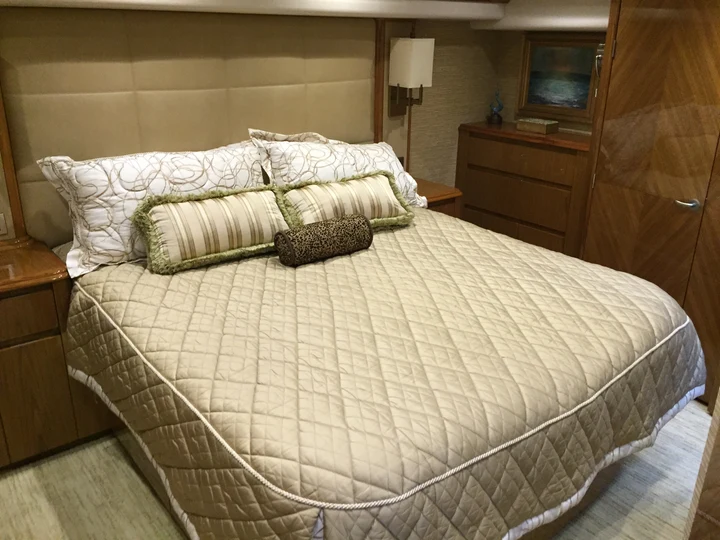
A custom mattress can also form part of a coordinated cabin interior where bedding, upholstery, and other finishes follow a consistent design.
V-berths are among the clearest examples of why standard rectangular mattresses can be unsuitable on boats. The berth generally narrows toward the bow, creating a shape that requires careful patterning.
A mattress can be manufactured to follow the changing width and angles of the berth while maintaining a usable sleeping surface.
Bunk and Pullman berths often have tighter dimensions and specific clearance requirements. Mattress thickness can be particularly relevant where headroom or access is limited.
Separate sections can also make installation, removal, and storage more practical.
Crew and captain sleeping areas may have compact or unusual berth configurations. Custom sizing can help make use of the available space without relying on a generic mattress size.
The construction can also be selected according to how frequently the berth is used and the preferences of the intended occupant.
Mattress construction affects comfort, support, weight, durability, and overall performance. The appropriate material depends on the intended use, design requirements, and personal comfort preferences.
Memory foam can provide a cushioning feel and contouring support. It is often considered where pressure distribution and a softer surface response are desired.
Its characteristics should be evaluated alongside mattress thickness and the ventilation conditions of the berth.
Latex provides a distinct combination of responsiveness and support. It can be considered when a sleeper prefers a surface that responds more quickly than traditional memory foam.
The overall mattress construction remains important because latex can be combined with other layers to achieve a particular comfort profile.
High-resiliency polyfoam can provide supportive cushioning while allowing manufacturers to tailor the mattress to different firmness requirements.
It can also be used in custom-shaped mattresses where the foam must be cut accurately to match the berth.
Innerspring construction can provide a more traditional mattress feel, while combination designs can bring together different materials and comfort layers.
The choice should account for the mattress dimensions, available clearance, weight considerations, and the desired sleeping experience.
Accurate measurements reduce the risk of gaps, interference with surrounding structures, and problems during installation. A detailed measurement should capture more than the overall length and width.
Measure the berth at several points rather than assuming that its width remains consistent. Forward berths can change significantly from one end to the other.
Length should also be measured according to the actual mattress footprint rather than simply measuring the surrounding cabin.
Document unusual corners, tapers, curves, cut-outs, and changes in shape. These details can determine whether the finished mattress sits correctly within the berth.
Where the mattress meets cabinetry or other structures, the available clearance should also be considered.
Mattress height affects both comfort and fit. A thicker mattress may provide additional cushioning, but the available vertical clearance must be checked.
Cabinet doors, berth lids, storage compartments, and surrounding structures can all influence the practical mattress height.
A mattress can be designed around the practical requirements of the berth rather than treated as a single fixed block.
Hinged sections can make it easier to access storage below the berth. They can be incorporated into the mattress configuration according to the location and movement required.
Corners can be cut to correspond with the berth instead of leaving awkward gaps. This is particularly useful for tapered and irregular sleeping platforms.
Additional comfort layers can modify the feel of the sleeping surface without necessarily replacing the underlying mattress construction.
The surrounding marine environment should be considered when selecting mattress coverings and finishes. Materials need to be appropriate for the cabin conditions, cleaning requirements, and expected level of use.
A mattress is only one part of the sleeping area. Its dimensions and appearance can affect how bedding and nearby upholstery fit together.
Custom bedding can be shaped to suit the same berth dimensions. Fitted sheets, quilts, comforters, and other bedding components can be coordinated with the mattress configuration.
This is particularly useful for berths with tapered ends or unusual corners where conventional bedding can bunch or leave excess material.
The mattress, bedding, upholstery, and headliner can be considered as parts of one cabin interior. Coordinated materials, textures, and colors can create a consistent appearance without compromising the practical requirements of the sleeping space.
Canvas Designers provides custom marine interior products and fabrication services covering mattresses, bedding, upholstery, quilting, and related yacht interior requirements.
A yacht mattress may need replacement when it no longer provides adequate support, has developed permanent impressions, shows deterioration, or no longer fits the berth properly.
Changes to the cabin can also create a reason for replacement. A refit may involve new joinery, altered storage access, different upholstery, or a redesigned sleeping arrangement. In these situations, a mattress made to the updated berth dimensions can be incorporated into the new interior.
Yes. Custom marine mattresses can be patterned around tapered sides, angled corners, and other irregular berth shapes. Accurate measurements are required so the finished mattress corresponds with the actual sleeping platform.
Yes, a replacement mattress can be specified with a different foam construction when the berth dimensions and available clearance are suitable. Foam selection should take firmness, support, thickness, and intended use into account.
There is no single thickness suitable for every yacht berth. The choice depends on the available clearance, berth construction, desired comfort, foam type, and surrounding cabin features.
Yes. Hinged sections can be incorporated where access to storage beneath the berth is required. Their position and configuration should be planned around the berth’s storage openings and surrounding structures.
Yes. Custom mattresses can be produced for different berth configurations, including bunk and crew sleeping areas. Custom sizing is particularly useful where space, clearance, or berth dimensions differ from standard mattress sizes.
A yacht mattress has to fit the space it occupies, support the way it will be used, and work with the rest of the cabin. Irregular berth shapes, limited clearance, storage access, and personal comfort preferences all influence the final specification.
Custom fabrication provides room to address these requirements together. Accurate patterning, appropriate foam selection, suitable thickness, and practical features such as hinged sections can produce a mattress that works with the vessel instead of leaving the cabin to accommodate a standard size.
For specifications, measurements, material choices, or a project discussion, you can contact the marine fabrication team directly.