Newsletter Subscribe
Enter your email address below and subscribe to our newsletter

 ByJohn A
Industrial spaces can experience significant heat buildup because of machinery, production processes, workers, lighting and limited air movement. Cooling these areas requires more than simply lowering the temperature. Air movement, ventilation, cooling coverage and installation requirements all need to be considered together.
A portable industrial air cooler uses evaporative cooling to deliver cooled air to selected areas without requiring a permanent duct network. Its mobility makes it suitable for spaces where cooling requirements can vary between work zones or where installing fixed equipment is impractical.
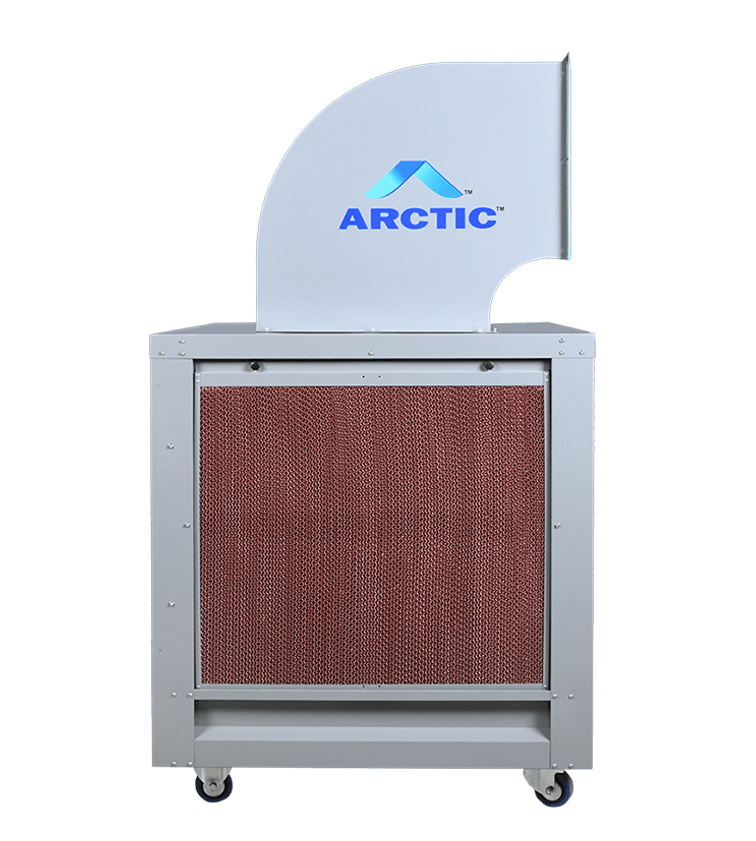
A portable industrial air cooler is an evaporative cooling unit designed to move air through water-moistened cooling pads before distributing the cooled air into the surrounding area. The evaporation process reduces the temperature of the air while the fan or blower provides the airflow needed to circulate it.
Unlike fixed cooling systems, portable units can be positioned closer to the area requiring cooling. This can be useful in industrial environments where different sections may experience different levels of heat.
ARCTIC describes its free-flow cooling equipment as suitable for indoor and outdoor applications, with portable models designed for spot cooling across industrial and commercial environments.
Industrial layouts are rarely uniform. A production area may have machinery concentrated in one section, while another part of the building may require considerably less cooling. A portable unit allows cooling equipment to be moved according to operational requirements.
This also reduces the need for permanent ductwork in areas where a fixed air distribution system may not be practical.
The cooling process involves several stages, beginning with the intake of warm surrounding air and ending with the distribution of cooled air into the required area.
The cooler draws warm ambient air through its air intake. Portable industrial models may use multiple intake sides to increase the amount of air entering the unit.
The effectiveness of this stage depends on unobstructed air intake and sufficient airflow around the cooler. Positioning therefore has a direct effect on how effectively the unit can circulate air.
Once warm air enters the cooler, it passes through wet evaporative cooling pads. Water contained in the pads evaporates as air moves through them.
The evaporation process absorbs heat from the incoming air, lowering its temperature before the air is discharged. This approach also introduces fresh air into the surrounding environment rather than relying on continuously recirculated indoor air.
After passing through the cooling section, the cooled air is pushed into the target space by the unit’s fan or blower.
Air throw becomes particularly relevant in industrial settings because the cooled air needs to reach the intended work area. Units with stronger airflow and suitable discharge arrangements can distribute cooled air across a greater distance.
Cooling pads and airflow work together. The pads provide the surface through which evaporation occurs, while the fan or blower moves air through the system and into the surrounding area.
Pad thickness, pad area, airflow volume and evaporation efficiency can all influence cooling performance. These specifications should therefore be considered alongside the size and layout of the space.
Portable evaporative coolers can serve several types of industrial and commercial spaces. Their suitability depends on factors such as ventilation, area size, heat load and the required cooling pattern.
Factory floors can contain machinery and processes that create concentrated heat. A portable cooler can provide airflow toward selected working areas without requiring the entire facility to be cooled through a central system.
This makes spot cooling useful where heat is concentrated around particular equipment or sections of the production floor.
Warehouses often have large open spaces where cooling the entire volume of air may require substantial infrastructure. Portable evaporative cooling can provide localized airflow in occupied or heat-affected areas.
The effectiveness of evaporative cooling also depends on adequate ventilation and the surrounding environmental conditions.
Workshops may have changing layouts, machinery and individual workstations. A mobile cooler can be positioned according to the current arrangement, allowing airflow to be directed toward areas where cooling is required.
Portable cooling can also be used in commercial environments such as offices, restaurants, canteens, shopping areas, gymnasiums, schools and other large spaces.
The free-flow product range described on the website includes applications such as commercial complexes, banquets, marriage halls, kitchens and general manufacturing facilities.
Portability becomes particularly useful when permanent duct installation is restricted by building design, available space or operational requirements.
A portable system can provide cooling without requiring the extensive installation work associated with a fixed ducted arrangement.
Mobility is more than a convenience. It can change how cooling is managed across a facility.
A portable unit can be repositioned as work areas change. This is useful where different sections have varying cooling requirements throughout the day.
Instead of installing separate fixed equipment for every area, one mobile unit can be directed toward the required location when appropriate.
Ducted systems require planned air distribution routes and installation space. A portable cooler can reduce the need for permanent ductwork in applications where localized cooling is sufficient.
This can also make the cooling setup less dependent on the building’s existing structure.
The free-flow portable range is designed around straightforward installation and operation. The website describes these units as plug-and-play coolers, making them suitable where a relatively simple cooling setup is preferred.
The exact electrical and water requirements still need to be checked before installation.
Portable cooling can direct airflow toward specific locations instead of distributing the same level of cooling throughout an entire building.
This approach can be useful for workstations, machinery areas or sections where heat accumulation is more noticeable.
Choosing a unit requires more than looking at its physical size. The specifications should correspond with the conditions of the space.
Check the unit’s airflow capacity, generally expressed in cubic metres per hour. Higher airflow capacity can support larger areas, but the required level depends on the layout and ventilation of the space.
Manufacturers may provide an indicative cooling area for individual models. Use this information as a starting point and consider the building’s heat load, air movement and environmental conditions.
Air throw indicates how far discharged air can travel under specified conditions. A unit with insufficient throw may not deliver cooled air effectively to the intended location.
Electrical specifications should match the available power supply. Portable industrial models can have different voltage, phase and power requirements depending on their size and configuration.
Evaporative cooling requires water. Check tank capacity, water supply arrangements and the practical requirements for refilling or maintaining the system.
Fan and blower operation produces sound. For occupied spaces, consider the operating environment and select equipment appropriate for the required noise conditions.
The choice between portable and ducted cooling depends largely on the building layout and how cooling needs to be distributed.
Spot cooling is suitable when specific areas require more airflow than others. A portable unit can be placed close to the required location and repositioned when necessary.
This approach can also work well where permanent ducting is difficult to install.
See also: How Do Rod Holder Shade Poles Work on a Boat Without Drilling?
A ducted system can be more appropriate when cooled air needs to reach multiple defined areas through a planned distribution network.
It can provide a structured method of distributing air across a facility where localized portable cooling would not adequately cover the required areas.
Building structure, ceiling height, access routes and available installation space all affect the choice.
Portable equipment can avoid some of the structural requirements associated with fixed duct systems, particularly where installation space is limited.
If several areas need simultaneous cooling, the required airflow distribution should be assessed carefully. Depending on the layout, multiple portable units or a ducted arrangement may be considered.
The decision should be based on airflow requirements, cooling coverage, installation limitations and operating conditions.
Construction and equipment design affect the suitability of a portable cooler for demanding environments.
Industrial cooling equipment may operate in environments where durability is important. The free-flow range uses a pre-coated galvanised steel body, providing a construction intended for industrial and commercial applications.
Cooling pad area and thickness influence the contact between incoming air and the evaporative surface. The appropriate configuration depends on the model and its intended airflow capacity.
The fan or blower determines how air is moved through the cooler and discharged into the space. Centrifugal blower arrangements can provide strong air movement for applications requiring greater air throw.
Castor wheels and a portable design allow the unit to be moved between locations. Mobility is particularly useful when cooling requirements change across a facility.
Regular maintenance should include attention to cooling pads, water systems, air intake areas and other components. Equipment that allows practical access to these areas can make routine servicing easier.
A portable industrial air cooler is a mobile evaporative cooling unit that draws warm air through water-moistened cooling pads and distributes cooled air into the surrounding area. It is designed for applications where localized or movable cooling is required.
Yes. Portable industrial coolers can be used on factory shop floors, workshops and manufacturing areas. Their suitability depends on factors such as heat load, ventilation, required airflow and the size of the area being cooled.
They can be suitable for warehouses, particularly where localized cooling and air movement are required. Warehouse ventilation, humidity, heat sources and the desired cooling area should be assessed before selecting a model.
A portable cooler does not automatically replace a ducted system. Portable equipment is generally suited to spot cooling and flexible applications, while ducted systems are designed for planned distribution of cooled air across multiple areas.
Consider airflow capacity, cooling area, air throw, electrical requirements, water capacity, mobility, construction and operating conditions. The unit should be selected according to the space layout and the specific cooling requirements rather than physical size alone.
Portable evaporative cooling provides a practical option for industrial and commercial spaces that require flexible air movement and localized cooling. Its main distinction from fixed systems is the ability to position the equipment where cooling is required without depending on a permanent duct network.
The right setup depends on the space, airflow requirements, heat sources, ventilation and the number of areas requiring cooling. Comparing these factors with the specifications of available units can help establish whether a portable cooler, ducted system or another evaporative cooling configuration is appropriate.
For product suitability, technical requirements or application-related questions, use the Contact page to discuss the cooling requirements for your space.