Newsletter Subscribe
Enter your email address below and subscribe to our newsletter

 ByJohn A
Your carry-on bag is going to be your best travel buddy. It’ll be placed in overhead bins, thrown on hotel floors, dragged through airports, and somehow expected to retain everything in it and be attractive enough to impress in the Denver meeting. No pressure, right? The reality is, not every leather bag is the same, and picking the incorrect bag could make your enterprise journey a nightmare. Before you make a reservation for your flight, let’s discuss what is really significant in picking the ideal leather travel handbag.
The cold, hard truth of the matter is that airports are leather’s kryptonite. A bag’s structural integrity is tested at security screening machines, when it’s handled by baggage handlers, and when it collides with a suitcase corner, the latter of which, by itself, is a “mishap. A bag’s structural integrity is tested in security screening machines, when it’s handled by baggage handlers, and when it collides with a suitcase corner, which never is a “mishap”. If the leather bag isn’t made properly, it will start ripping, wrinkling, and ruining before you have even landed. A well-made one? It’ll come out battle-tested but unsplit.
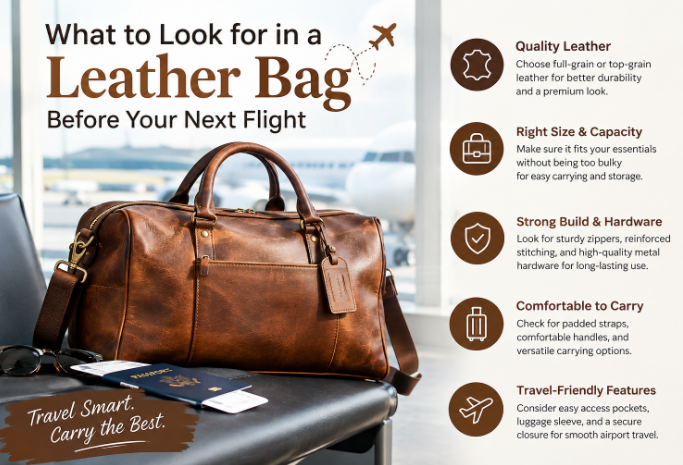
First, consider the quality of leather. The very best leather is the full grain; it has every mark and scratch on it, and that’s a good thing. It also implies that the hide has not been sanded, which in turn makes it very durable. It also ensures you’ll get a stunning patina that will tell the tale of your travels. Top-grain leather is lightly tanned, but still looks wonderful. Anything less (corrected grain, bonded leather) will peel, crack, and fail rapidly. Check with the manufacturers: Full-grain or top-grain? Avoid “all of the above” or “some of them” responses.
Stitching is also important. Hand seams are stronger than machine seams because they are stitched evenly. Look for double or triple stitching at stress points such as handles, corners, and attachment points. If it seems thin and the stitches are far apart, go to the next one. This bag won’t last a week in an airport.
Travel bags must have a sweet size: big enough so that you can put all your stuff in, but not too big so that they don’t fit in the airline carry-on. The size of the bags is usually up to 22 x 14 x 9 inches, with the majority of airlines permitting them. If you exceed the limit, you’ll have to check your bag, and that defeats the point of being “carry-on. If you exceed the limit, you must check your bag and that’s the opposite of being “carry-on. Take careful measurements and keep in mind that leather will stretch slightly under load.
Organization matters more than most travelers realize. An unstructured leather travel bag might look sleek, but it becomes a black hole where chargers mysteriously vanish and documents fold at weird angles. Look for a bag with dedicated pockets a padded laptop compartment, a front organizational panel with slots for pens and boarding passes, and an inside zippered pocket for valuables. Some premium bags include RFID-blocking pockets, which protect your passport and credit cards from digital theft. That might sound paranoid, but airport security breaches are real.
The weight of the bag itself is also important. While leather is heavier than nylon, quality leather bags strive to be as light as possible without compromising on durability. Collect the empty bag and evaluate. Is it floppy or structurally sound? The bag that flattens out when empty, will be a nightmare when it’s full.
Though leather is often considered to be the perfect water pairing, this is not always true. A high-quality leather will certainly take in water; it is cheap leather that warps and crackles when wet. There is a subtle difference people fail to notice: The process used to tan the cloth will dictate how waterproof it is. Once treated appropriately, vegetable-tanned leather that is made with natural tannins is just as water-repellent as leather tanned using chemicals. Chrome-tanned leather is different and needs to be finished.
Before purchasing, ask if this leather is treated for waterproofing. Some bags are given a beeswax end, silicone coating or other special sealing process, which provides protection without sacrificing the natural breathability of leather. Some manufacturers say “waterproof,” but that is unnecessary and typically refers to plastic coating that chokes leather. It’s like it has found its middle ground, it is not waterproof, nor is it water absorbent, it is water resistant, which means it will not make your bag into a plastic shell when it rains.
Now, you might see travel bags labeled “vegan leather,” and it’s worth understanding what that actually means. What is vegan leather? It’s a synthetic alternative made from plant-based or petroleum-based materials designed to mimic leather’s look and feel. Common types include cork leather, pineapple leather (Piñatex), mushroom leather, and polyurethane-based options.
Is vegan leather real leather? No. It’s a synthetic substitute. Vegan leather meaning essentially comes down to this: it’s leather without any animal products.
That raises an interesting question: what is a vegan leather exactly? Most plant-based options still require plastic backing or binding, making them technically not biodegradable.
Lower upfront cost and ethical appeal. Its disadvantage? It doesn’t age like genuine leather, doesn’t develop character, and often deteriorates faster.
For travel specifically, vegan leather is a mixed bag. Some premium options are genuinely durable, while others crack and peel within a year. If you’re choosing between cheap vegan leather and high-quality genuine leather, genuine leather wins every time for travel durability.
Here’s where many travelers miss the mark: they focus on brand names instead of actual construction. A backpack with a famous logo isn’t necessarily better than one made by a dedicated leather craftsperson. Alaskan Leather Backpacks represent exactly this philosophy—they prioritize materials and methods over marketing hype. These aren’t the flashiest bags, but they’re designed by people who understand what travelers actually need.
The best bags come from makers who’ve been refining their craft for years. They know which leather grades work for travel. They understand stress points and reinforce them accordingly. They’ve listened to thousands of travelers and incorporated feedback into their designs. An Alaskanleathercompany.com focuses on these details because their reputation depends on it. They can’t hide behind anonymity or fast-fashion excuses. Every bag carries their name and commitment.
Before committing to any leather travel bag, verify: full-grain or top-grain leather? Double-stitched at stress points? Carries within airline dimensions? Organizational pockets included? Water-resistant treatment applied? Can you access customer reviews from long-term users? Does the manufacturer offer a warranty or replacement guarantee?
Your travel bag isn’t just luggage it’s an investment in stress-free trips. Choose thoughtfully, and it’ll carry you through decades of adventures.